A quiet-boom supersonic business jet
A 12-seat Mach 1.6 business jet shaped like NASA's X-59 so its boom reaches the ground as a thump, and the leanest programme that could get it certified.
2026 changed the supersonic question: NASA’s X-59 flew, and the FAA proposed a new rule for flying over land. So I asked what a business jet built on the X-59’s boom-shaping principle would look like, and what the cheapest path to market would be. Every number comes from one sizing model: atmosphere, engine thrust lapse calibrated on Concorde’s Olympus, supersonic drag build-up, component weights, mission closure, and a shaped-boom law calibrated on the X-59.
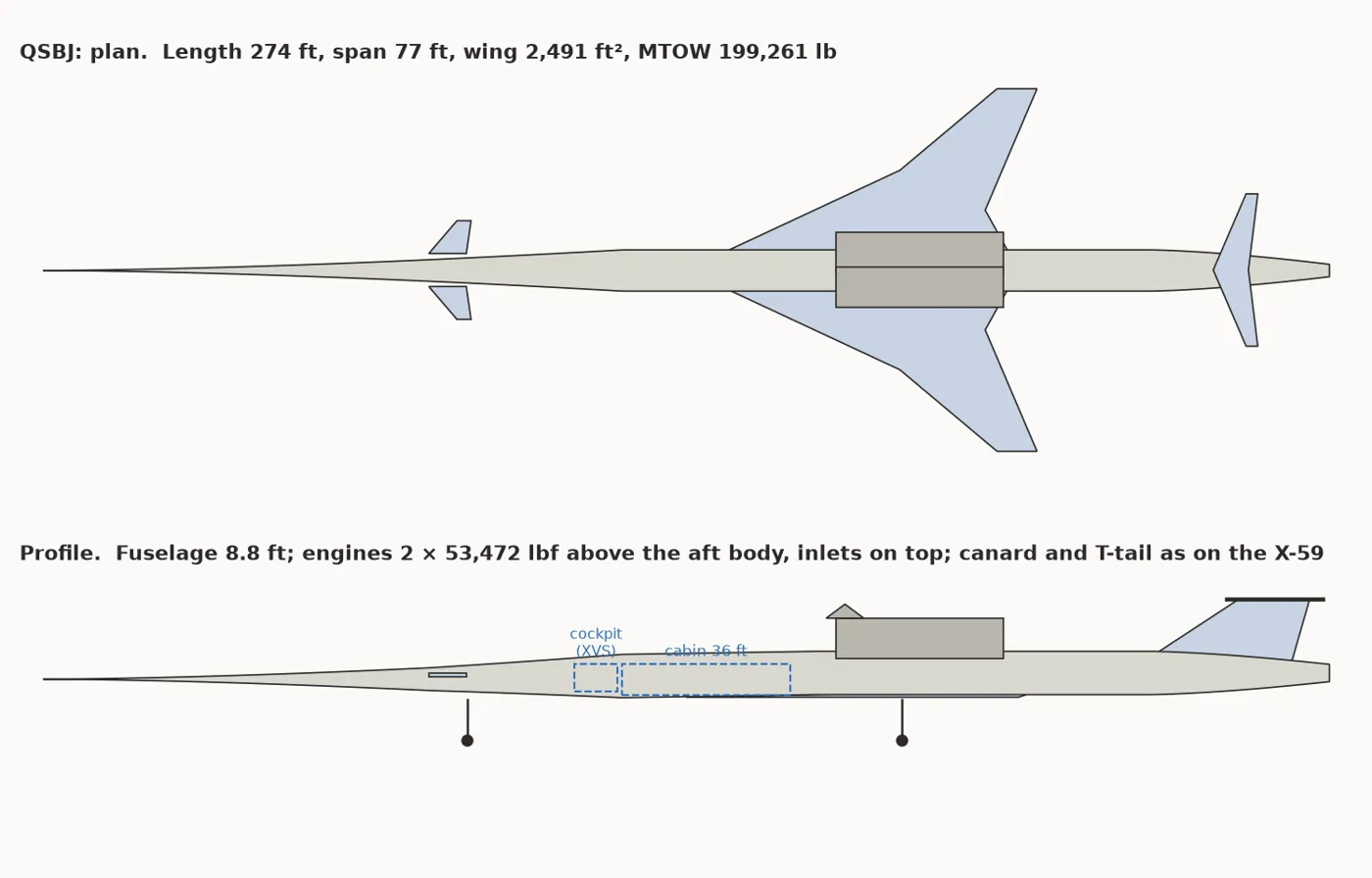
What came out
A 12-passenger, 4,500 nmi, Mach 1.6 jet with a large-business-jet cabin, shaped to a 78 PLdB thump, is a 199,000 lb, 274 ft aeroplane with two 53,500 lbf engines. That’s the length of a 747-8 on 767-class engine cores.
- Shaping sets the length. For a quiet boom the aeroplane has to be long: in the model, 3 dB quieter costs about a quarter more length.
- Shaping is cheap in weight and expensive in certainty. The quiet shape costs only about 7% in takeoff weight over an unshaped jet. Its real cost is that the nose, tail, inlets and engine position are all dictated by the boom, and only one aeroplane has ever flown the method.
- The engine is the hard part. A civil engine keeps less than a quarter of its static thrust at Mach 1.6. The engines are sized by cruise, and they end up airliner-core engines, not business-jet engines.
- Over land, it flies at “Mach cutoff.” Under the FAA’s proposed rule it cruises at about Mach 1.1–1.17, where the boom never reaches the ground.
The lean programme comes to roughly $5.5–6 billion to cash breakeven, with a type certificate in about eight years.
I also put Boom’s published Overture through the same model as a sanity check.